
Description
School of Spanish Flag Fish (Lutjanus Carponotatus)
Corals provide essential habitat structure and energy in coral reef systems, facilitating the existence of numerous reef associated species. Indo-Pacific coral reefs are home to over 600 species of hard corals (also called stony corals or scleractinian corals), and 4000-5000 species of reef fishes (Veron 2000, Lieske and Myers 2001). There are strong mutual dependencies between the reef-building corals and reef-inhabiting fishes, with many fish species depending on corals for food and habitat, while corals depend on the grazing by certain fishes for reproductive success. Even the spread of coral diseases may be mitigated by fishes. This article summarises what is known about these intricate mutual relationships.
Corals as food

Description
Chevron butterflyfish (Chaetodon trifascialis) feeds exclusively on Acropora hyacinthus.

Description
Coral reef with plate coral (Acropora hyacinthus) in the foreground. Hard corals create and maintain the hard substrate of coral reefs through the production of their calcium carbonate skeletons. They also provide habitat and shelter for the vast diversity of other species that make coral reefs such productive and beautiful systems.

Description
Black-backed butterflyfish (Chaetodon melannotus), which feeds mainly on soft coral.

Description
Tubelip wrasse (Labrichthys unilineatus), which feeds on coral mucous.
Coral reef fishes have developed a wide array of feeding modes to harness the diversity of food sources on coral reefs. Corals themselves have not avoided being on the menu despite substantial energy investments in structural and chemical defences to deter would be predators (Gochfeld 2004). Globally, there are some 130 species of corallivorous fishes (fishes that consume live coral tissue) from 11 different families, although Butterflyfishes (family Chaetodontidae) account for approximately half of all of these (Cole et al. 2008). Corallivorous fishes can be highly specialised, such as the chevron butterflyfish (Chaetodon trifascialis), which feeds almost exclusively on a single coral species Acropora hyacinthus (Pratchett 2005). Most corallivorous fishes target <scleractinian ‘hard’ corals>, although a handful of species, such as the black-backed butterflyfish (Chaetodon melannotus), clearly prefer alcyonarian ‘soft’ corals; (Cole et al. 2008). Some fishes have an ‘obligate’ association with their coral prey, meaning the majority of their diet is centred on coral, and approximately one third of all corallivorous fishes fall in to this category. Other corallivorous fishes include coral as measurable part of their diet but also utilise other food items. These fishes are known as ‘facultative’ corallivores and tend to do better than ‘obligate’ corallivores after coral loss from disturbance, such as crown-of-thorns starfish, storms or <coral bleaching> (Wilson et al. 2006; Pratchett et al. 2009).
There are three main feeding modes amongst corallivorous fishes: polyp-feeders, mucous-feeders and skeletal-feeders. Polyp-feeders use their forceps-like mouths to remove individual coral polyps, but do so without damaging the underlying coral skeleton (Cole et al. 2008). Earlier studies provided evidence that the chronic pressure of this feeding mode represents a substantial energetic cost to coral (Neudecker 1979; Cox 1986; Kosaki 1989). A recent study estimated that butterflyfishes consume up to 6% of the standing tissue biomass of corals per year (Cole et al. in press), and are therefore likely to influence the distribution, abundance and community composition of corals.
Due to the cryptic way in which many corallivores feed it is often difficult to identify exactly what food these fishes are targeting (Nagelkerken et al. 2009), however, it is clear that one set of corallivores seek the mucous produced by corals (Rotjan and Lewis 2008). Mucous production by corals may account for up to half of the energy assimilated by zooxanthellae (Wild et al. 2004)and may be a relatively rich energy source for species able to digest it, comparable to that available in coral tissue (Cole et al. 2008). One example of a mucous-feeder is the tubelip wrasse (Labrichthys unilineatus) which is found throughout the Indo-Pacific.
Skeletal-feeders represent an altogether greater impact on corals. As the name suggests, such corallivores scrape the coral surface and in doing so damage the underlying skeleton. Several studies have shown that recovery times for corals are significantly extended when the coral skeleton has to be repaired along with the surface tissue (Gochfeld 2004; Jayewardene and Birkeland 2006; Bonaldo and Bellwood 2009). Skeletal-feeding species have a greater potential to impact the physical structure of coral reefs, especially the larger species whose deep bites effectively excavate the coral skeleton causing substantial damage to the coral species which they selectively target. Most notable of these species is the bumphead parrotfish (Bolbometopon muricatum) which is found in the Pacific and can consume up to 13.5kg m-2 of live coral per year and more than 5t of reef skeleton per year (Bellwood et al. 2003).

Description
A school of bumphead parrotfish (Bolbometopon muricatum) foraging on the front reef slope.

Description
A digitate hard coral (Acropora sp.) bearing the classic signs of fish predation. Knobs of coral have been bitten off whole, probably by the bumphead parrotfish (Bulbometopon muricatum).
Coral as habitat and refuge
Even a little coral loss will lead to a decline in the abundance of reef fishes. This is not unique to coral reefs, as other ecosystems which experience loss of the dominant habitat forming taxa (e.g. kelp) exhibit comparable effects following habitat degradation. Some effects of coral loss on fishes will become evident over a relatively short time frame (weeks/months), such as reduced physiological condition and reproductive activity (Pratchett et al. 2004). Over the longer term (years) this may lead to lower abundance and diversity of fishes (Wilson et al. 2006). Many disturbances of coral reefs do not result in immediate loss of habitat structure. Coral bleaching; and Crown-of-thorns starfish; kill corals but their skeletons may remain intact for years until erosion takes its toll. Dead coral habitat which has retained its structural complexity may continue to support abundant and diverse reef-fish communities (Lindahl et al. 2001). Nonetheless the rapid decline of some coral reef fishes following tissue loss suggests that living coral is an important attribute of the coral reef habitat (Wilson et al. 2006).

Description
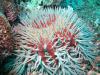
Crown of Thorns starfish (COTS) (Acanthaster planci) feed by extending their stomach out their mouth and directly on the coral. In this way they can feed irrespective of the shape of their prey.

Description
Whole colony bleaching of Platygyra sp. and partial bleaching of branching coral (Acropora sp.) on Erskine reef in 2006.
The loss of structural complexity has even more serious implications for the health of fish communities (Garpe and Öhman 2003; Halford et al. 2004). In one study, both the abundance and diversity of the community declined by approximately two-thirds after the reef collapsed in to a formless rubble state (Sano et al. 1987). It is possible that this figure does not even reflect the full extent of species loss as small fishes often go uncounted in community studies owing to their cryptic nature (Wilson et al. 2006). It also not straightforward to predict the future survival potential of different fishes, and some species may show increases in abundance following coral mortality (Wilson et al. 2006).
The settlement potential of fishes after having spent their larval phase as plankton in the water column is also shaped by coral health. A study in Papua New Guinea observed almost two-thirds of all fishes associating with live coral once they settled on to the reef after their larval stage (Jones et al. 2004). It appears that many fishes prefer to settle near to live coral even if the adults are not coral dependent, and will actively avoid settling in to dead coral (Feary et al. 2007a, Feary et al. 2007b). Owing to a lack of information on the specific habitat requirements of coral reef fishes during their early life history it is difficult to assess the impact of coral loss on fish settlement (Wilson et al. 2006).

Description
Scissortail sergeant majors (Abudefduf sexfasciatus) hover close to a branching coral (Acropora sp.); a quick refuge in the event of any danger.
After settling on a coral reef a variety of processes, including predation, competition, living space and food availability, will determine the success of an individual or the local population of a particular species (Syms and Jones 2000). But how do these processes relate to the two distinct phases of habitat degradation? Loss of live coral (biological degradation) in the absence of physical degradation has greatest negative impact on coral-dwelling species (Munday 2004). This suggests that fishes who actually ‘live’ in live coral, such as certain species of goby, are unable to adapt to new habitats if they cannot find their favoured one. It may be that living coral confers camouflage benefits onto its resident fishes. One recent study on the Great Barrier Reef [GBR] found that coral-dwelling damselfishes occupying bleached or dead coral hosts were more susceptible to predation than the same species occupying healthy coral colonies (Coker et al. 2009). As discussed above, live coral provides a direct food source for some fishes. However it may also provide an indirect food source, by creating favourable conditions in which other prey items such as invertebrates may flourish (Halford et al. 2004).
Physical degradation of a coral reef reduces both the complexity of the environment and the actual ‘physical space’ of the reef matrix. This has logical implications for the quality and quantity of refuge (shelter) provided by the reef. Where fishes are unable to successfully compete for the prime refuge sites they are at substantially greater risk of being predated upon (Holbrook and Schmitt 2002). Increased structural complexity also helps to mediate competition for living space and food resources (Munday et al. 2008). Given the exacerbating effect of structural reef loss on fish communities it can be assumed that the role of coral reefs in providing refuge is a key process in regulating diversity and abundance of reef fishes (Garpe et al. 2006).
Fishes as facilitators of coral settlement
Successful settlement of coral planulae (free-swimming larvae) on to the reef substrate and survival thereafter are critical to the long-term health of coral reefs as coral populations require constant replenishment. Having discussed the many benefits corals bring to fishes, there are certain functional groups of fishes that in turn facilitate this settlement and survival of corals. These are broadly termed ‘herbivores’, meaning that they consume predominantly plant material.
As discussed <above>, the scraping and excavating role of certain corallivorous fishes will damage corals. Some of these fishes also consume turf algae: small algae (usually <1cm high) growing on the reef substratum. Many species of parrotfishes (Scarini) perform this role. The unique shapes of their jaws, which are fused and beak-like, actually scrape clean the substratum on which they feed (Bellwood 1994). This action provides new sites for coral planulae to settle (Bonaldo and Bellwood 2009). Many herbivorous parrotfishes do not feed on corals at all, such as the rivulated parrotfish (Scarus rivulatus), which is one of the most abundant species of parrotfish on the <inner-shelf reefs of the GBR> (Fox and Bellwood 2007). However, it should be noted that larger parrotfish species play a more profound role in exposing clean reef substrate for coral settlement, owing to their deep ‘excavating’ bites (Bellwood 1994). Most notable among these species are large individuals (>35cm) of humphead parrotfish (Bolbometopon muricatum) and steephead parrotfish (Chlorurus microrhinos) whose bites expose the reef substrate for up to seven days, increasing the potential for coral planulae to settle successfully (Bonaldo and Bellwood 2009).

Description
A school of rivulated parrotfish (Scarus rivulatus) forage along the front reef slope.

Description
Steephead parrotfish (Chlorurus microrhinos) feed on coral leaving exposed reef substrate.

Description
A brown surgeonfish (Acanthurus nigrofuscus) foraging among the algal slime growing on soft coral.
Another functional group of herbivorous fishes are the ‘grazers’. Much like a lawn mower, these fishes keep the growth of turf algae in check by literally grazing the reef substrate. This serves to limit the growth of macroalgae (large strands of algae >5cm), which would otherwise outcompete corals for space and light. Although the actual mass of algae consumed by an individual may be relatively small, because many species of grazers school (move in large groups) and are relatively abundant their overall impact is considered significant (Green and Bellwood 2009). Many herbivorous grazers are in the Surgeonfish family (within the Genus Acanthurus), of which the most abundant of species on the GBR is likely to be the Brown surgeonfish (Acanthurus nigrofuscus) (Bellwood and Fulton 2008). The negative effect of grazing herbivores on the survival of coral spat is likely to be overestimated (Penin et al. 2010) given that spat which settle on to turf algae do not recruit well (become adult corals) anyway (Birrell et al. 2005).

Description
A huge school of unicornfish (Naso unicornis) vigorously parading around the reef slope on the front reef. This type of schooling and frantic activity usually precedes a spawning event.
In sufficient quantities, macroalgae has been shown to limit the potential for coral planulae to settle on to the reef and to outcompete coral spat for resources as they attempt to grow (Hughes et al. 2007). Herbivorous fishes that eat macroalgae are called ‘browsers’ and play an important role in removing macroalgae which would otherwise stifle the replenishment of coral populations (Hughes et al. 2007). Despite being an important functional role there are only a handful of fishes that can perform this task, on mid-shelf and outer-shelf reefs of the GBR only one species, the bluespine unicornfish (Naso unicornis) is thought to responsible for keeping macroalgal growth in check (Hoey and Bellwood 2010). Fundamental variation of processes such as wave energy and sedimentation, also shape coral reef communities across the GBR and also partly explain the differences in the composition of benthic (substrate) communities across the continental shelf. Whilst functional groups of fishes might vary from one location to another based on these different conditions (Hoey and Bellwood 2008), none of them have high levels of functional redundancy, meaning that these roles are performed by only a handful of species (Bellwood et al. 2003). Therefore it is important that herbivores are given protection from unsustainable fishing practices to ensure that these roles remain a functional part of ecosystem interaction. One such method of conservation is the use of marine reserves, which either limit or prohibit fishing such as the green zones on the GBR. Whilst such measures are an important part of the solution, the top down preservation of herbivorous fishes will ultimately not prevent the loss of coral reefs if bottom up processes such as increased pollution, coral bleaching and sedimentation degrade the habitat on which the fishes themselves depend (Allison et al. 1998; Jones et al. 2004).
Fishes as vectors of coral disease
A relatively recent debate is emerging about the role that corallivorous fishes can play in transmitting coral disease when feeding on coral. One laboratory study found that a Caribbean butterflyfish which fed on a diseased coral transmitted it to other coral colonies (Aeby and Santavy 2006), whilst another found a correlation between coral disease and the abundance of corallivorous butterflyfishes (Raymundo et al. 2009). Interestingly, a recent pilot study found that corallivorous fishes would actually target the disease portion of the coral and by doing so appeared to slow the progression of the disease through the coral (Cole et al. 2009). It is therefore unclear whether corallivorous fishes help to spread or slow the progression of coral disease, and this remains a topic for future research.
References
- Aeby GS, Santavy DL (2006) Factors affecting susceptibility of the coral Montastraea faveolata to black-band disease. Marine Ecology Progress Series 318:103-110
- Allison G, Lubchenco J, Carr MH (1998) Marine reserves are necessary but not sufficient for marine conservation. Ecological Applications 8:1
- Bellwood DR (1994) A phylogenetic study of the parrotfishes (Pisces: Labroidei), with a revision of genera. Australian Museum,Sydney
- Bellwood DR, Fulton CJ (2008) Sediment-mediated suppression of herbivory on coral reefs: Decreasing resilience to rising sea levels and climate change? Limnology and Oceanography 53:2695-2701
- Bellwood DR, Hoey AS, Choat JH (2003) Limited functional redundancy in high diversity systems: resilience and ecosystem function on coral reefs. Ecology Letters 6:281-285
- Birrell CR, McCook LJ, Willis BL (2005) Effects of algal turfs and sediment on coral settlement. Marine Pollution Bulletin 51:408-414
- Bonaldo RM, Bellwood D (2009) Dynamics of parrotfish grazing scars. Marine Biology 156:771-777
- Coker DJ, Pratchett MS, Munday PL (2009) Coral bleaching and habitat degradation increase susceptibility to predation for coral-dwelling fishes. Behavioral Ecology 20:1204-1210
- Cole A, Chong Seng K, Pratchett M, Jones G (2009) Coral-feeding fishes slow progression of black-band disease. Coral Reefs 28:965-965
- Cole AJ, Pratchett MS, Jones GP (2008) Diversity and functional importance of coral-feeding fishes on tropical coral reefs. Fish and Fisheries 9:286-307
- Cox EF (1986) The effects of a selective corallivore on growth rates and competition for space between two species of Hawaiian corals. Journal of Experimental Marine Biology and Ecology 101:161-174
- Diaz-Pulido G, McCook LJ, Dove S, Berkelmans R, Roff G, Kline DI, Weeks S, Evans RD, Williamson DH, Hoegh-Guldberg O (2009) Doom and Boom on a Resilient Reef: Climate Change, Algal Overgrowth and Coral Recovery. PLoS ONE 4:e5239
- Feary DA, Almany GR, Jones GP, McCormick MI (2007a) Coral degradation and the structure of tropical reef fish communities. Marine Ecology Progress Series 333:243-248
- Feary DA, Almany GR, McCormick MI, Jones GP (2007b) Habitat choice, recruitment and the response of coral reef fishes to coral degradation. Oecologia 153:727-737
- cFox RJ, Bellwood DR (2007) Quantifying herbivory across a coral reef depth gradient. Marine Ecology Progress Series 339:49-59
- Garpe KC, Öhman MC (2003) Coral and fish distribution patterns in Mafia Island Marine Park, Tanzania: fish–habitat interactions. Hydrobiologia 498:191-211
- Garpe KC, Yahya SAS, Lindahl U, Öhman MC (2006) Long-term effects of the 1998 coral bleaching event on reef fish assemblages. Marine Ecology Progress Series 315:237-247
- Gochfeld DJ (2004) Predation-induced morphological and behavioral defenses in a hard coral: implications for foraging behavior of coral-feeding butterflyfishes. Marine Ecology Progress Series 267:145-158
- Green AL, Bellwood DR (2009) Monitoring functional groups of herbivorous reef fishes as indicators of coral reef resilience – A practical guide for coral reef managers in the Asia Pacific region. IUCN working group on Climate Change and Coral Reefs IUCN, Gland, Switzerland:70
- Halford A, Cheal AJ, Ryan D, Williams DM (2004) Resilience to large-scale disturbance in coral and fish assemblages on the Great Barrier Reef. Ecology 85:1892-1905
- Hatcher BG (1988) Coral reef primary productivity: A beggar's banquet. Trends in Ecology & Evolution 3:106-111
- Hoey A, Bellwood D (2008) Cross-shelf variation in the role of parrotfishes on the Great Barrier Reef. Coral Reefs 37:37-47
- Hoey A, Bellwood D (2010) Cross-shelf variation in browsing intensity on the Great Barrier Reef. Coral Reefs 29:499-508
- Holbrook SJ, Schmitt RJ (2002) Competition for shelter space causes density-dependent predation mortality in damselfishes. Ecology 83:2855-2868
- Hughes TP, Rodrigues MJ, Bellwood DR, Ceccarelli D, Hoegh-Guldberg O, McCook L, Moltschaniwskyj N, Pratchett MS, Steneck RS, Willis B (2007) Phase Shifts, Herbivory, and the Resilience of Coral Reefs to Climate Change. Current Biology 17:360-365
- Jayewardene D, Birkeland C (2006) Fish predation on Hawaiian corals. Coral Reefs 25:328-328
- Jones GP, McCormick MI, Srinivasan M, Eagle JV (2004) Coral decline threatens fish biodiversity in marine reserves. Proceedings of the National Academy of Sciences of the United States of America 101:8251-8253
- Kosaki RK (1989) Predation by Chaetodon trifasciatus and growth and distribution of Pocilliopora damicornis at Coconut Island, Oahu, Hawaii. Pacific Science 43
- Lieske, E, Myers, R (2001) Coral Reef Fishes: Indo-Pacific and Caribbean. Princeton University Press
- Lindahl U, Öhman MC, Schelten CK (2001) The 1997/1998 Mass Mortality of Corals: Effects on Fish Communities on a Tanzanian Coral Reef. Marine Pollution Bulletin 42:127-131
- Munday PL (2004) Habitat loss, resource specialization, and extinction on coral reefs. Global Change Biology 10:1642-1647
- Munday PL, Jones GP, Pratchett MS, Williams AJ (2008) Climate change and the future for coral reef fishes. Fish and Fisheries 9:261-285
- Nagelkerken I, Van Der Velde G, Wartenbergh SLJ, Nugues MM, Pratchett MS (2009) Cryptic dietary components reduce dietary overlap among sympatric butterflyfishes (Chaetodontidae). Journal of Fish Biology 75:1123-1143
- Neudecker S (1979) Effects of grazing and browsing fishes on the zonation of corals in Guam. Ecology 60:666-672
- Ohman MC, Rajasuriya A, Svensson S (1998) The use of butterflyfishes (Chaetodontidae) as bio-indicatiors of habitat structure and human disturbance. Universitetsforlaget, Oslo, Norway
- Penin L, Michonneau F, Baird A, Connolly S, Pratchett M, Kayal M, Adjeroud M (2010) Early post-settlement mortality and the structure of coral assemblages. Marine Ecology Progress Series 408:55-64
- Pratchett M (2005) Dietary overlap among coral-feeding butterflyfishes (Chaetodontidae) at Lizard Island, northern Great Barrier Reef. Marine Biology 148:373-382
- Pratchett MS, Wilson SK, Berumen ML, McCormick MI (2004) Sublethal effects of coral bleaching on an obligate coral feeding butterflyfish. Coral Reefs 23:352-356
- Pratchett MS, Baird AH, McCowan DM, Coker DJ, Cole AJ, Wilson SK (2009) Protracted declines in coral cover and fish abundance following climate-induced coral bleaching on the Great Barrier Reef. 11th International Coral Reef Symposium
- Raymundo LJ, Halford AR, Maypa AP, Kerr AM (2009) Functionally diverse reef-fish communities ameliorate coral disease. Proceedings of the National Academy of Sciences 106:17067-17070
- Rotjan RD, Lewis SM (2008) Impact of coral predators on tropical reefs. Marine Ecology Progress Series 367:73-91
- Sano M, Shimizu M, Nose Y (1987) Long-term effects of destruction of hermatypic corals by Acanthaster planci infestation on reef fish communities at Iriomote Island, Japan. Marine Ecology Progress Series 37:191-199
- Syms C, Jones GP (2000) Disturbance, habitat structure and the dynamics of a coral-reef fish community. Ecology 81:2714-2729
- Veron JEN, Stafford-Smith MG (2000) Corals of the World. AIMS, Townsville
- Wild C, Huettel M, Klueter A, Kremb SG, Rasheed MYM, Jorgensen BB (2004) Coral mucus functions as an energy carrier and particle trap in the reef ecosystem. Nature 428:66-70
- Wilson SK, Graham NAJ, Pratchett MS, Jones GP, Polunin NVC (2006) Multiple disturbances and the global degradation of coral reefs: are reef fishes at risk or resilient? Global Change Biology 12:2220-2234
Related content