

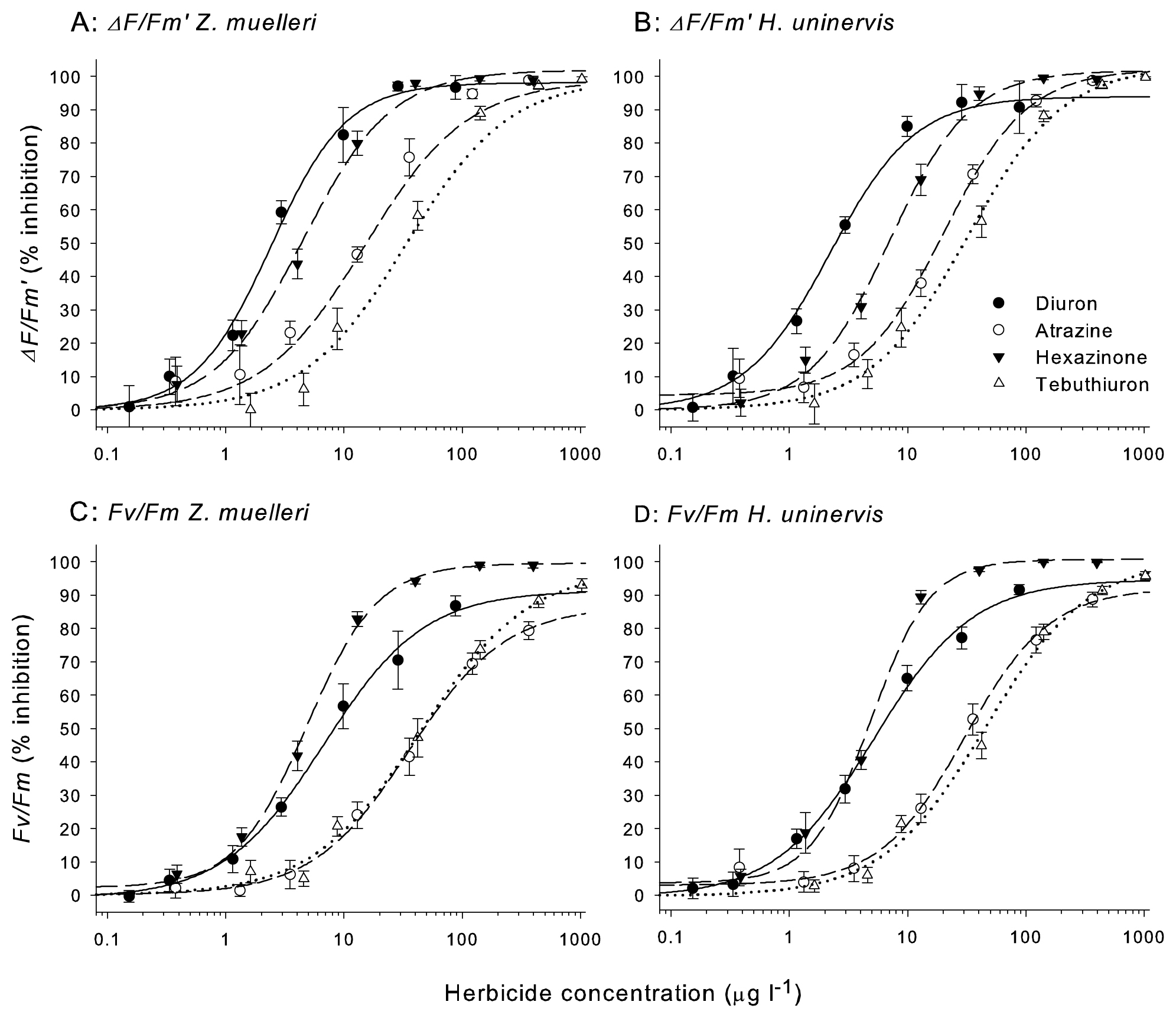
Concentration-response curves for two seagrasses species and four herbicides.

Description
Percent inhibition relative to control for effective quantum yield (ΔF/F’m) and maximum potential yields (Fv/Fm) in Zostera muelleri and Halodule uninervis;exposed to PSII herbicides over 72 h. doi:10.1371/journal.pone.0075798.g002
The close proximity of seagrass meadows to flood plumes has raised concerns that seagrasses may be the species most threatened by herbicides from runoff and seagrasses therefore have been a priority for toxicity testing on the GBR in research funded by NERP TE. The herbicides Diuron, Atrazine, Hexazinone and Tebuthiuron caused rapid reduction in photosynthesic capacity in two seagrass species tested. Diuron was consistently the most potent herbicide to both seagrass species followed by Hexazinone, Atrazine and Tebuthiuron.