
Dispersal distances of assigned juveniles from Keppel Island group marine reserves
Description
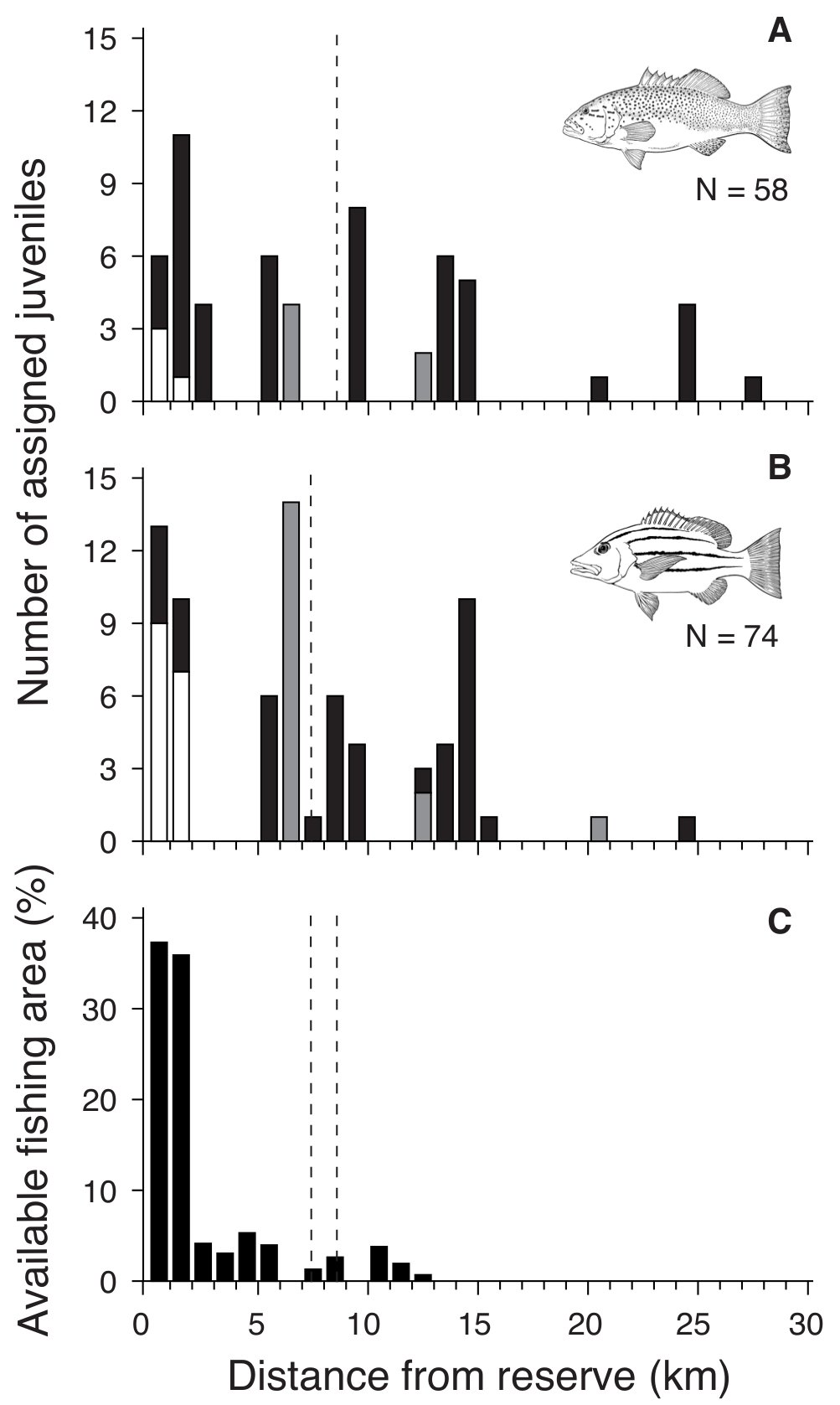
(A and B) The frequency distributions of realized dispersal distances indicate that within the Keppel Islands, assigned juvenile P. maculatus (A) and L. carponotatus (B) were collected between 100’s of meters and 28 km from the location where their parents were sampled (average observed dispersal distance is indicated by the dashed vertical lines: 8.6 km ± 1.0 km SEM for P. maculatus and 7.4 km ± 0.6 km SEM for L. carponotatus). Each histogram bar is divided according to the number of assigned juveniles that returned to natal reserves (white), the number that dispersed from one reserve to another reserve (gray) and the number that dispersed from reserves to fished areas (black). (C) The distribution of available reef area open to fishing that surrounds each of the six marine reserves is within the mean dispersal range of both species (dashed vertical lines).