
Where
Coral Sea Marine Park
Who
Reef Life Survey is a non-profit citizen science program in which trained SCUBA divers undertake standardised underwater visual surveys of reef biodiversity on rocky and coral reefs around the world.
When
2012 - 2021
Why
The Coral Sea Marine Park is of global significance for pristine shallow coral reefs which are home to some of the highest fish biomass and shark numbers found anywhere. These coral reefs are managed within a system of Habitat Protection and National Park Zones that are designed to manage direct human usage, but the area has experienced major heatwaves over the last 20 years that have caused mass coral bleaching. The two largest of these occurred in 2016 and 2020. This research investigated the impacts of each of these, and the combined impact of both, on the marine life on Coral Sea reefs.
 Graham Edgar
Description
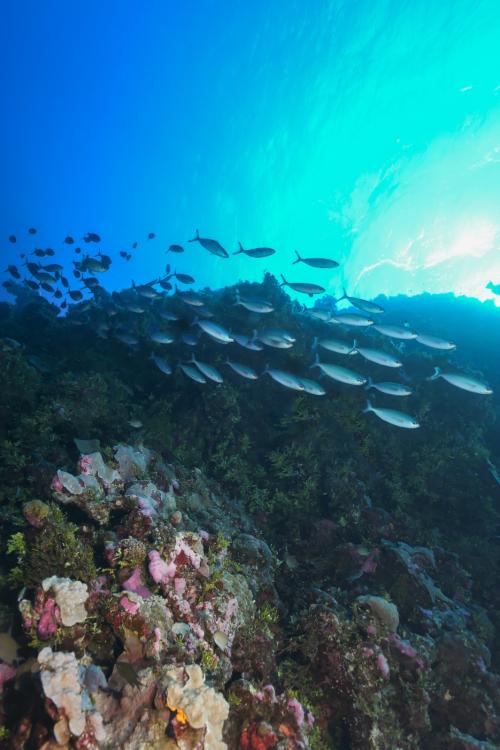
The exposed reef crest at Magdelaine Cay drops steeply into water over 500m deep
How
Biodiversity surveys were conducted on 793 underwater transects at 143 sites spanning the full length of the Coral Sea Marine Park between 2012 and 2021. Each survey involved divers laying out 50 m transect lines along the reef and counting large and small fishes and mobile macroinvertebrates (e.g., sea urchins, clams, crustaceans). Photographs were taken along each transect to record organisms growing on the substrate, such as corals, sponges, and seaweeds. Surveys were repeated three times at most of the sites, all using the same methods, allowing biodiversity change to be investigated in relation to each bleaching event, and overall.
What did we learn
The 2016 bleaching event impacted corals in the north, and the 2020 event more in the centre and south (Fig 1), leading to overall mean declines in hard coral cover across the Coral Sea Marine Park from 17% to 14% across the study period (equivalent to a loss of 17% of the living hard corals recorded in the original surveys). Fish communities responded very differently to each heatwave and to associated coral cover changes. The overall biomass of fish per transect increased in the north after the 2016 heatwave, regardless that coral had declined over the same period, however fish biomass subsequently decreased from 2018. Shark biomass also dropped at many reefs. Overall, the makeup of fish communities (species and abundances) in the south and far north became more similar to those in the central region over the course of the study, making fish composition in north and south regions less distinct in 2021 than observed in original surveys.
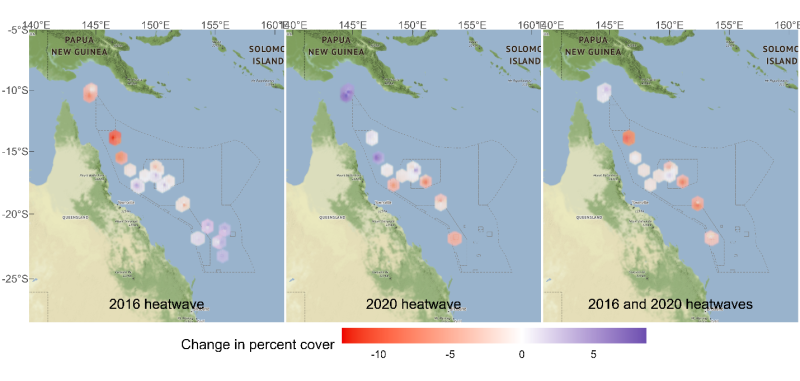
Figure 1. Changes in live hard coral cover associated with the 2016 heatwave (left), the 2020 heatwave (middle) and overall (right). The 2016 heatwave-associated coral changes reflect the difference between values observed on surveys before 2016 versus after 2016 but before 2020. The 2020 changes reflect differences in values from after the 2016 event but before the 2020 event, versus after the 2020 event. Changes in percent cover are absolute changes and do not depend on the initial cover, so a decline from 30% cover to 20% would be shown as a 10% decline.
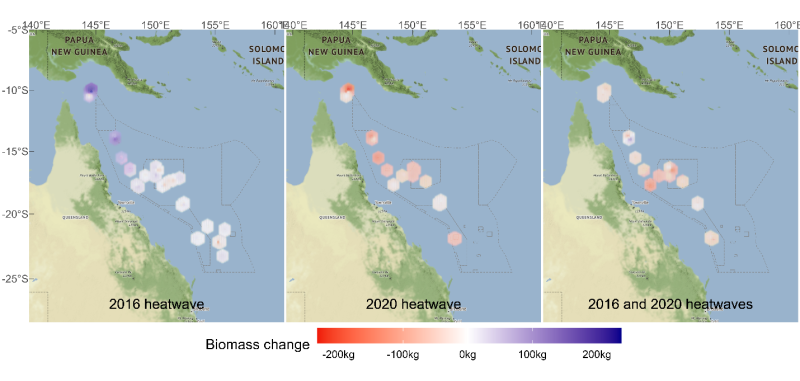
Figure 2. Changes in total fish biomass observed on reef transects associated with the 2016 heatwave (left), the 2020 heatwave (middle) and overall (right). The 2016 heatwave-associated fish biomass changes reflect the difference between values observed on surveys before 2016 versus after 2016 but before 2020. The 2020 changes reflect differences in values from after the 2016 event but before the 2020 event, versus after the 2020 event.
These changes make monitoring and management difficult because the causes of many changes do not appear to be as simple as coral cover declines or warmer seas. The main conclusion is that environmental change has likely caused recent biodiversity change across the Coral Sea that has swamped any potential effects of changed management following inauguration of the Coral Sea Marine Park.
What next
Recommend further investigation and monitoring of the key drivers of change in reef biodiversity across the regions. Understanding monitoring data and management effectiveness in the region will require careful consideration of the background changes occurring independently of management effort, through continued data collection and appropriate statistical tests. The studies may lead to a better understanding of change in the Coral Sea Marine Park, including if increasing higher protection management zones will reduce other impacts such as illegal fishing activity and contribute to maintaining fish biomass and shark populations.
 Dr Rick Stuart-Smith
Description
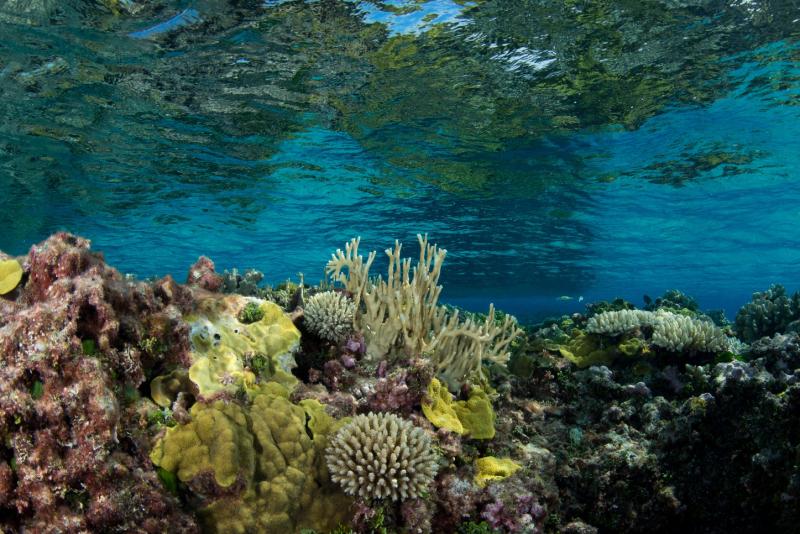
Colourful, complex, coral structures make up the shallow reefs at Bird Islet, Coral Sea
Related data and publications
- Heather FJ, Stuart-Smith R, Cooper A, Turak E, and Edgar G (2022) Biodiversity change in the Coral Sea Marine Park over the past decade and major heatwaves. Reef Life Survey Foundation Incorporated.