
Where
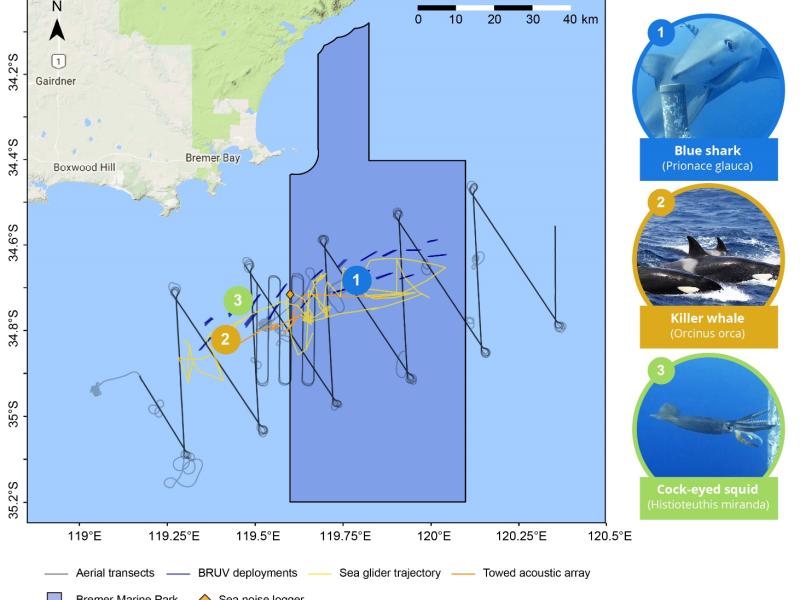
Multiple sites located both inside and to the west and east of the Bremer Marine Park.
Who
Professor Jessica Meeuwig (University of Western Australia), Dr. Phil Bouchet (University of Western Australia), Professor Charitha Pattiaratchi (University of Western Australia), Professor Christine Erbe (Curtin University of Technology), Ms Rebecca Wellard (Curtin University of Technology), Mr John Totterdell (Marine Information and Research Group Australia). Funding by NESP Marine Biodiversity Hub (Emerging Priorities Program), Parks Australia, Integrated Marine Observing System (IMOS), Ian Potter Foundation.
When
February to April 2017
Why
A thriving ecotourism industry has recently developed in the Bremer Bay region, where numerous offshore submarine canyons attract high numbers of ocean wildlife including dolphins, sharks, seabirds, and the largest seasonal aggregation of killer whales in the Southern Hemisphere. Despite increasing awareness of the region as a biodiversity hotspot, little is known of when and how animals use the area. For instance, existing data indicate that most killer whales are encountered west of the Bremer Marine Park (119.6°E), but it is unclear whether they may also occur within its boundaries. This project was designed to provide the first regional picture of megafauna distribution patterns within and around the Bremer Marine Park. Such knowledge is critical as a baseline for future monitoring and will help support management decisions foe the park.
How
The region was surveyed with a combination of sampling methods, including visual transects from an aircraft (following conventional protocols), underwater video transects using drifting mid-water baited cameras (stereo-BRUVS), passive acoustic recordings using a hand held hydrophone, biopsy sampling, and water profiling using a deep-diving autonomous underwater vehicle (Seaglider). The project enabled the first ever deployments of stereo-BRUVS within the Bremer Marine Park, setting an important precedent for establishing monitoring baselines using cost-effective, non-invasive approaches. It also built upon the results of a previous IMOS glider mission conducted in 2013. Several previously undocumented individual killer whales were identified photographically, and images added to the Project ORCA catalogue. All data processing and analysis were carried out at the University of Western Australia and Curtin University.
Description
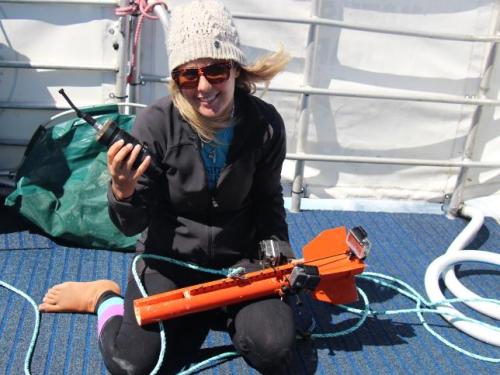
PhD candidate Rebecca Wellard prepares to deploy a towed acoustic logger.
What did we learn?
Four cetacean species were reliably identified during aerial surveys: the killer, long-finned pilot and sperm whales, and the bottlenose dolphin. These complement sightings of false killer whales, as well as common, spinner and striped dolphins made during vessel-based operations. The majority of species were seen as single animals or in pairs, although several larger groups of pilot whales, killer whales and bottlenose dolphins, 10–60 individuals strong, were also recorded. Both pilot and sperm whales were widespread throughout the region, with the latter recorded on virtually every aerial transect. In contrast, killer whales were only detected close to, or westward of, the western park boundary, both from the air and underwater. Preliminary analyses revealed no apparent differences in the diversity or abundance of fish and shark species between sampling sites located inside and outside the Bremer Marine Park. Glider measurements confirmed that several different water masses interact in the region, and that the highest concentrations of chlorophyll occur at depth, though periodic mixing allows productivity to reach surface layers. Minimal hydrocarbon traces were detected during the sampling period.
Description
Wildlife and oceanographic surveys of the Bremer Marine Park. The Bremer Marine Park was sampled as part of a collaborative government funded program designed to provide critical baseline information on the presence of marine megafauna in the region and the potential physical factors affecting their distribution.
What next?
Processing acoustic recordings is ongoing and will contribute towards Rebecca Wellard’s PhD thesis entitled The bioacoustics of killer whales (Orcinus orca) in Australian waters. Repeat surveys (e.g. aerial, stereo-BRUVS) at different times of the year are critically needed to enhance our understanding of the variation in species occurrence and abundance across seasons and years. The Great West Ozzie Transect Project, led by Professor Jessica Meeuwig (Marine Futures Lab, University of Western Australia) and supported through funding from the Ian Potter Foundation, the Pangaea Initiative, North Port Marine, the Minderoo Foundation, Parks Australia, and private philanthropy, may provide an ideal platform for this and has already enabled the repeat sampling of several marine parks off Western Australia (e.g. Geographe, Perth Canyon).
Related data and publications
- Bouchet P, Wellard R, Erbe C, Meeuwig J. (2018) Aerial visual survey of cetaceans and other megafauna in the Bremer Marine Park and surrounding areas. Short communication produced for the NESP Marine Biodiversity Hub and Parks Australia, 4 p.
- Meeuwig J, Turner J. (2017) Bremer Canyon Progress Report - NESP Emerging Priorities Project EP2 (Spatial distribution of marine wildlife in the Bremer Bay region). Report prepared for the NESP Marine Biodiversity Hub, 18 p.
- Meeuwig J, Turner J, Bouchet P. (2016) Bremer Canyon Science Workshop Report - NESP Emerging Priorities Project EP2. Report prepared for the NESP Marine Biodiversity Hub, 27 p. DOI: 10.13140/RG.2.2.25891.35364.
- Dataset (2017) Aerial visual survey of cetaceans and other megafauna in the Bremer Marine Parl and surrounding areas (NESP Emerging Priorities EP2)
- Dataset (2017) Passive acoustic recordings of marine megafauna within the Bremer Marine Park and adjacent areas (NESP Emerging Priorities EP2)
- Dataset (2017) Pelagic baited camera (stereo-BRUVS) survey of the Bremer Marine Park and adjacent areas (NESP Emerging Priorities EP2)
- Bouchet, P, Meeuwig, J, Erbe, C, Salgado-Kent, C, Wellard, R and Pattiaratchi, C. (2018). Bremer Canyon Emerging Priorities Project EP2: Occurrence and distribution of marine wildlife in the Bremer Bay region. Final Report. National Environmental Science Programme, Marine Biodiversity Hub. University of Western Australia, 32 p.
- Web application showcasing the results of the aerial survey programme
- Surveying marine life in canyons off Bremer Bay project webpage
- YouTube clip of pelagic stereo-BRUV deployment highlights
For more information please contact marinescience@environment.gov.au.