 Mr David Welch (James Cook University)
Description
Introduction to broad grey mackerel and why they are important
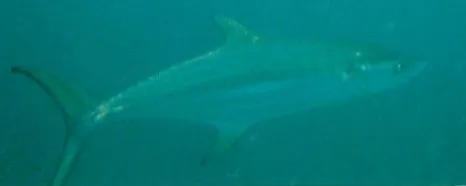
Grey mackerel (Scomberomorus semifasciatus) is a large and highly mobile schooling fish and its known preferred habitat is turbid inshore waters of tropical and sub-tropical areas. The species is endemic to the northern Australian region and ranges from Moreton Bay in southeast Queensland, north along the Queensland coast to the southern parts of Papua New Guinea, and then west across the top of northern Australia to Shark Bay on the mid-Western Australian coastline (Charters et al. 2010; Collette and Russo 1984). At certain times of the year they can be found schooling around rocky headlands and inshore reefs (D. Welch, pers. obs.).
Grey mackerel are an important commercial fishery species and are targeted primarily using gillnets, often in association with sharks also targeted in inshore net fisheries. A detailed description of these fisheries is given in Welch et al (2009).
 Dr Eric Lawrey (eAtlas (Australian Institute of Marine Science)), NESP TWQ 3.3.3, Dave Welch
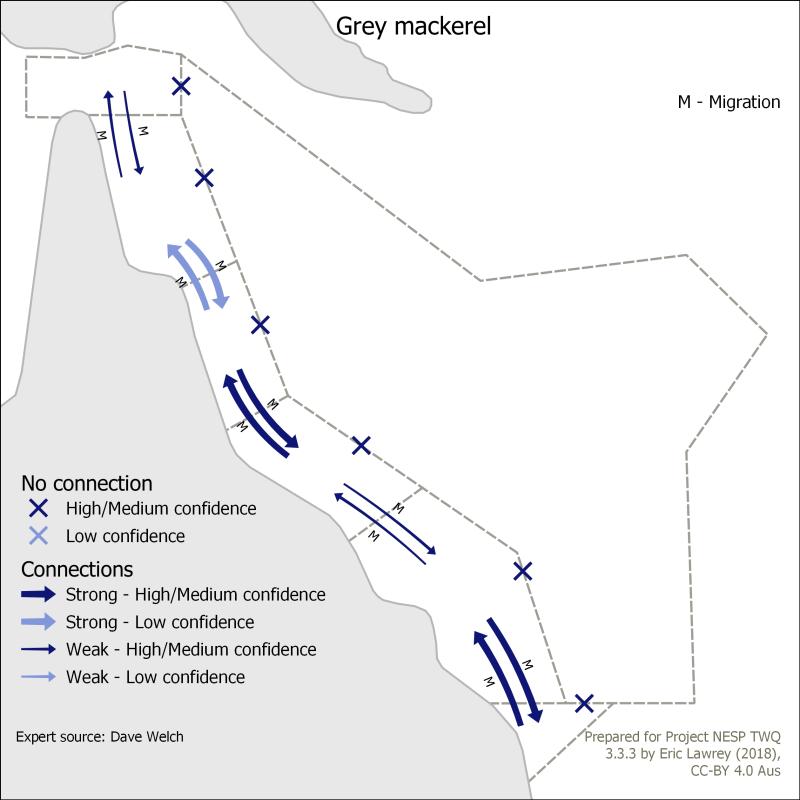
Figure 2. This map shows the connectivity of Grey mackerel in the Great Barrier Reef and its surrounding areas: Torres Strait, Coral Sea and Great Sandy regions. The arrows indicate the strength and nature of the connection between the regions. This map is intended to identify where one region is dependent on a neighbouring region.
Additional notes: This map does not show the connectivity between subregions of the GBR but only with its surrounding regions.
The data for this map was developed based on expert opinion (Dave Welch).
Key concepts that relate to connectivity
Grey mackerel are found in large schools along the entire east coast, particularly from August to January, which encompasses their spawning season (Welch et al 2009). Once hatched, larvae of this species move to the inner margins of coastal bays and also into estuaries (Jenkins et al., 1985). Grey mackerel are fast growing, early maturing and highly fecund (Cameron and Begg 2002; Crofts and de Lestang, 2004; Welch et al 2009).
Research has identified at least five different stocks of grey mackerel across the northern coast of Australia based on differences in growth, genetics, parasites and otolith stable isotopes (Figure 4; Welch et al 2009; Welch et al 2015). There is a clear distinction between fish sampled on the east coast compared to other areas farther west, however no sampling was done in Torres Strait. It is therefore uncertain whether Torres Strait grey mackerel are more highly connected with the east coast or the Gulf of Carpentaria. Reported catches in the Torres Strait are very low suggesting that the area is more of a geographical separation point between eastern and western stocks rather than a region of significant stock connectivity. Evidence is also provided of smaller subdivisions occurring within these areas and of minor shared stocks within the Gulf of Carpentaria (see Charters et al. (2010) and Newman et al. (2010)). On the east coast a northern and southern stock have been identified separated at approximately Bowen (20° S). Consequently, monitoring of grey mackerel stocks by the Queensland Department of Agriculture ad Fisheries separate these regions for assessment of stock status.
Based on the results of Welch et al (2009) it is likely that there is connectivity between the southern section of the GBRMP and the Sandy Strait and the fish are part of the southern northeast coast stock. Further, connectivity between Torres Strait and the northern section of the GBRMP is likely and may either be low due to movement of fish from the northern east coast stock, or in fact may be strong due to the presence of a northern Cape York stock. The sampling locations of Welch et al (2009) cannot resolve this and we have assumed connectivity to be low due to low relative abundance in Torres Strait.
 Saunders et al (2014)
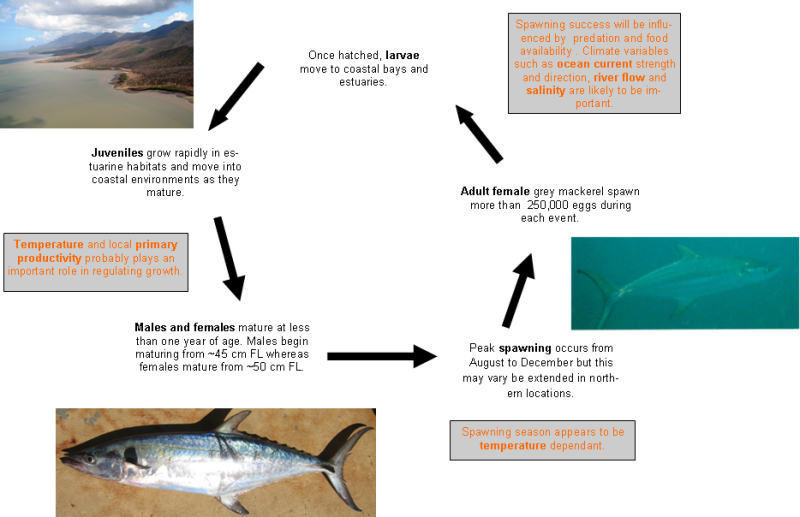
Figure 3. The life cycle of grey mackerel showing the narrow use of the coastal fringe during different life history stages.
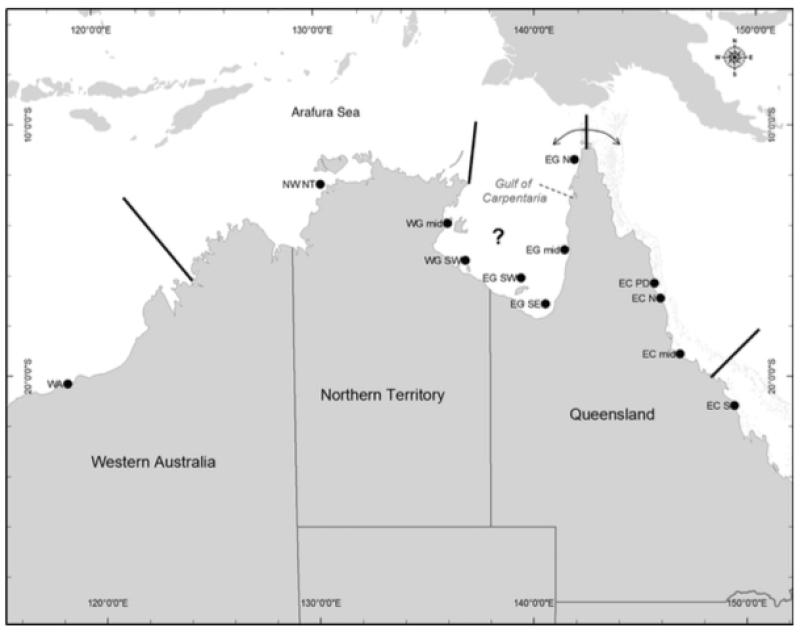 Mr David Welch (James Cook University), et al 2015
Figure 4. This map shows results of a stock structure study for grey mackerel which suggested separate stocks at spatial scales of hundreds of kilometres and that on the east coast there are at least two separate stocks. Dots show sampling locations and lines indicate where there was evidence of separate stocks and approximate boundaries. It is possible that the northern section of Cape York represents a single stock that includes Torres Strait however sampling resolution cannot resolve this.
References
- Cameron, D. and Begg, G. (2002) Fisheries biology and interaction in the northern Australian small mackerel fishery. Final report to the Fisheries Research and Development Corporation, Projects 92/144 & 92/144.02, 236p.
- Charters, R.A., Lester, R.J.G., Buckworth, R.C., Newman, S.J., Ovenden, J.R., Broderick, D., Kravchuk, O., Ballagh, A., Welch, D.J. (2010) The stock structure of Grey Mackerel Scomberomorus semifasciatus in Australia as inferred from its parasite fauna. Fisheries Research 101(1–2): 94–99.
- Collette, B.B. and Russo, J.L. (1984) Morphology, systematics, and biology of the Spanish mackerels (Scomboromorus, Scombridae). Fisheries Bulletin 82, 545-689.
- Crofts, N.J. and de Lestang, P. (2004) Fishnote No. 35. Department of Business, Industry and Resource Development, Northern Territory Government.
- Jenkins, G.P., Milward, N.E. and Hartwick, R.F. (1985) Occurrence of larvae of Spanish mackerels, genus Scomberomorus (Teleostei: Scombridae), in shelf waters of the Great Barrier Reef. Australian Journal of Marine and Freshwater Research 36, 635-640.
- Newman, S.J., Wright, I.W., Rome, B.M., Mackie, M.C., Lewis, P.D., Buckworth, R.C., Ballagh, A.C., Garrett, R.N., Stapley, J., Broderick, D., Ovenden, J.R., Welch, D.J., (2010) Stock structure of grey mackerel, Scomberomorus semifasciatus (Pisces:Scombridae) across northern Australia, based on otolith stable isotope chemistry. Env.Biol. Fish., 89: 357-367.
- Saunders, T., Welch, D.J. and Lawson, E. (2014) Grey mackerel (Scomberomorus semifasciatus) In: Welch, D.J., J. Robins, and T. Saunders (editors) (2014) Implications of climate change impacts on fisheries resources of northern Australia. Part 2: Species profiles. Final report to Department of Agriculture, Fisheries and Forestry, and the Fisheries Research and Development Corporation, Canberra, Australia. https://docs.wixstatic.com/ugd/9d521f_3bdc7908b0b84f25a8a17caf74903dac.pdf
- Welch, D.J., Buckworth, R.C., Ovenden, J.R., Newman, S.J., Broderick, D., Lester, R.J.G., Ballagh, A.C., Gribble, N.A., Stapley, J., Charters, R.A., Street, R. (2009) Determination of management units for grey mackerel fisheries in northern Australia. Final Report, Fisheries Research and Development Corporation Project 2005/010, Fishing & Fisheries Research Centre, James Cook University, Townsville, Australia, 166 pp. https://docs.wixstatic.com/ugd/9d521f_7f7afdf4c92a4098ae0e177479332cd2.pdf
- Welch, D.J., Newman, S.J., Buckworth, R.C., Ovenden, J.R., Broderick, D., Lester, R.J.G., Gribble, N.A., Ballagh, A.C., Charters, R.A., Stapley, J., Street, R., Garrett, R.N. and Begg, G.A. (2015) Integrating different approaches in the definition of biological stocks: a northern Australian multi-jurisdictional fisheries example using grey mackerel. Marine Policy, 55: 73-80. https://www.sciencedirect.com/science/article/pii/S0308597X15000214