Recent datasets

Northern Australian Reef Mapping through Georeferenced Media - Virtual Fieldwork Toolkit (NESP MaC 3.17, AIMS)

Published on
11 April 2024
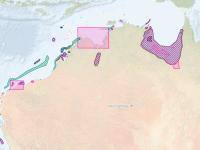
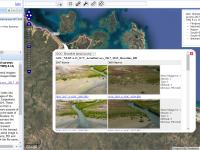
This dataset compiles georeferenced media - including videos (480), articles (20), and datasets (6) - specifically curated to facilitate the understanding of reef habitats across northern Australia. It was designed as a research tool for virtual fieldwork with a particular focus on identifying sources of information that allow an understanding of both inshore and offshore reef environments. This dataset provides a record of the literature and media that was reviewed as part of mapping the reef boundaries from remote sensing as part of project NESP MaC 3.17.
Lidar mapping and Gully Assessment December 2023 (DCCEEW, Contract SON3352211, Griffith Uni)

Published on
05 April 2024

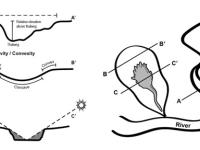
This dataset contains maps of alluvial and hillslope gullies across blocks of lidar covering portions of the Burdekin Catchment. This project is an expansion of the detailed gully mapping and assessment undertaken previously as part of NESP TWQ Project 5.10 (Daley et al., 2021), using newly available lidar as well as some older data not previously used. The gully polygons were generated using methods developed in the NESP TWQ 5.10 project for the extraction of gullies from lidar. Lidar is detailed topographic data collected from aircraft using an airborne laser scanning system.

Coral Sea Oceanic Vegetation (NESP MaC 2.3, AIMS)

Published on
18 March 2024

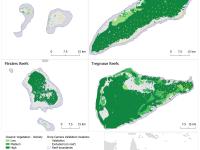
This dataset is a vector shapefile mapping the deep submerged aquatic vegetation on the bottom of the coral atoll lagoons in the Coral Sea within the Australian EEZ. This mapped vegetation predominantly corresponds to erect macroalgae, erect calcifying algae and filamentous algae (Tol, et al., 2023), with an average algae benthic cover of approximately 30 - 40%. This corresponds to only vegetation occurring on the soft sediment of the lagoons. This dataset was mapped from contrast enhanced Sentinel 2 composite imagery (Lawrey and Hammerton, 2022).

Marine satellite image test collections (AIMS)

Published on
18 March 2024

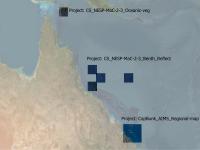
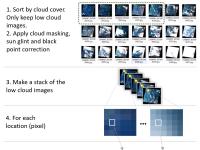
This dataset consists of collections of satellite image composites (Sentinel 2 and Landsat 8) that are created from manually curated image dates for a range of projects. These images are typically prepared for subsequent analysis or testing of analysis algorithms as part of other projects. This dataset acts as a repository of reproducible test sets of images processed from Google Earth Engine using a standardised workflow.

North Australia Sentinel 2 Satellite Composite Imagery - 15th percentile true colour (NESP MaC 3.17, AIMS)

Published on
06 March 2024

This dataset is true colour cloud-free composite satellite imagery optimised for mapping shallow marine habitats in northern Australia, based on 10-meter resolution Sentinel 2 data collected from 2015 to 2024. It contains composite imagery for 333 Sentinel 2 tiles of northern Australia and the Great Barrier Reef. This dataset offers improved visual clarity of shallow water features as compared to existing satellite imagery, allowing deeper marine features to be observed.

NESP MaC Project 4.6 - Developing Traditional Owner community-led dugong monitoring in the Kimberley region, 2024-2026 (JCU, ISWAG, DBCA)

Published on
22 February 2024

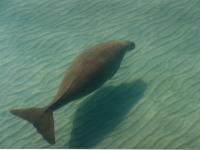
This record provides an overview of the NESP Marine and Coastal Hub study - Developing Traditional Owner community-led dugong monitoring in the Kimberley region. For specific data outputs from this project, please see child records associated with this metadata. Dugong are a keystone species with considerable ecological and cultural value across northern Australia. In the Kimberley region of Western Australia, dugongs have been identified as one of the top priorities to monitor in an effort to ensure the population is maintained and traditionally harvested in a sustainable manner.

NESP MaC Project 4.12 - Protecting valuable shoreline mangroves of northern Australia, 2024-2026 (JCU)

Published on
22 February 2024

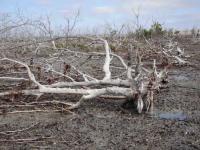
This record provides an overview of the NESP Marine and Coastal Hub study - Protecting valuable shoreline mangroves of northern Australia. For specific data outputs from this project, please see child records associated with this metadata. The mass death (~80 km2) and dieback of shoreline mangroves around the Gulf of Carpentaria (GOC) and across northern Australia in 1982 and 2015 was a wake-up call to the vulnerability and immense importance of marine coastal ecosystems like mangroves.

NESP MaC Project 4.24 - Towards assessing the values of reefs in the southern Gulf of Carpentaria, 2024-2025 (JCU)

Published on
22 February 2024

This record provides an overview of the NESP Marine and Coastal Hub project 'Towards assessing the values of reefs in the southern Gulf of Carpentaria 2024 - 2025'. For specific data outputs from this project, please see child records associated with this metadata. The Gulf of Carpentaria Marine Park was only recently declared in 2013. The zoning plan for this marine park, which permits trawling within a specific trawling zone is due for renewal by 2028.

NESP MaC Project 4.18 - Indigenous Ranger-led monitoring of threatened sawfish in the southern Gulf of Carpentaria, 2024-2026 (CSIRO, CLCAC)

Published on
22 February 2024

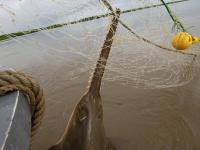
This record provides an overview of the NESP Marine and Coastal Hub project Indigenous Ranger-led monitoring of threatened sawfish in the southern Gulf of Carpentaria. For specific data outputs from this project, please see child records associated with this metadata. This project will partner scientists with First Nations Ranger groups to assess population abundance, distribution and by-catch survival for sawfish species in the southern Gulf of Carpentaria.

NESP MaC Project 4.17 - Supporting recovery and management of migratory shorebirds in Australia, 2024-2026 (UQ, DU)

Published on
22 February 2024

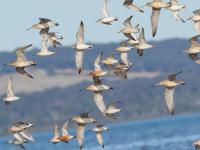
This record provides an overview of the NESP Marine and Coastal Hub project 'Supporting recovery and management of migratory shorebirds in Australia'. For specific data outputs from this project, please see child records associated with this metadata. Coastal Australia is home to 37 regularly occurring migratory shorebird species, with many protected areas including Ramsar sites designated on the basis of shorebird populations. Many migratory shorebirds are declining rapidly, and hence the focus of conservation efforts at multiple levels of government in Australia and overseas.

NESP MaC Project 4.2 - Assessing dugong distribution and abundance in the southern Gulf of Carpentaria, 2024-2026 (CDU, JCU)

Published on
22 February 2024

This record provides an overview of the NESP Marine and Coastal Hub study - Assessing dugong distribution and abundance in the southern Gulf of Carpentaria. For specific data outputs from this project, please see child records associated with this metadata. Aboriginal ranger groups, Traditional Owners of the southern Gulf of Carpentaria (sGoC), scientists, Queensland, Northern Territory and Commonwealth government representatives will co-design and implement a program that enables a contemporary cross-border understanding of dugong populations and other marine megafauna.

NESP MaC Project 4.1 - Coastal seagrass of the Gulf of Carpentaria: building knowledge and capacity as a foundation for long-term monitoring, 2024-2026 (JCU, CLCAC)

Published on
22 February 2024

This record provides an overview of the NESP Marine and Coastal Hub study - Coastal seagrass of the Gulf of Carpentaria: building knowledge and capacity as a foundation for long-term monitoring. For specific data outputs from this project, please see child records associated with this metadata. The Gulf of Carpentaria has a globally significant seagrass habitat, supporting dugongs, green turtles, and commercially important fish and prawns.

NESP MaC Project 4.13 - Mapping and characterising Australia’s tropical shellfish reefs, 2024-2026 (GU)

Published on
22 February 2024

This record provides an overview of the NESP Marine and Coastal Hub study 'Mapping and characterising Australia’s tropical shellfish reefs'. For specific data outputs from this project, please see child records associated with this metadata. This project will assess the current status of tropical oyster (also called shellfish) reefs across Northern Australia.

NESP MaC Project 4.5 - Developing an Integrated Pest Management Framework for Feral Pigs in Coastal Environments, 2024-2026 (NAILSMA)

Published on
22 February 2024

This record provides an overview of the NESP Marine and Coastal Hub study - Developing an Integrated Pest Management Framework for Feral Pigs in Coastal Environments. For specific data outputs from this project, please see child records associated with this metadata. Feral pig populations are recognised as a current and future threatening process across most of northern Australia’s species and ecosystems.

NESP MaC Project 4.11 - Scaling-up long-term seagrass restoration in the Cocos (Keeling) Islands, 2024-2026 (JCU)

Published on
22 February 2024

This record provides an overview of the NESP Marine and Coastal Hub study - Scaling-up long-term seagrass restoration in the Cocos (Keeling) Islands. For specific data outputs from this project, please see child records associated with this metadata. There is an urgent community-driven need to develop appropriate seagrass restoration approaches at scale for the Cocos (Keeling) Islands (CKI).

Vegetation and Elevation Surveys of the Gulf of Carpentaria Mangrove Dieback 2017 - 2019 (NESP TWQ 4.13, JCU)

Published on
16 January 2024

Vegetation and Elevation surveys were conducted at four sites in the Gulf of Carpenteria to provided crucial validation of observations made from aerial surveys and provided further significant insights of the impacts and subsequent changes that occurred across the Gulf coastline up to late 2019. Field studies primarily focused on shoreline fringing stands dominated by the Grey Mangrove Avicennia marina var. eucalyptifolia. A total of eight transects, perpendicular to the shoreline were established at four shoreline sites across the Gulf of Carpentaria.

Estuary assessments of the Gulf of Carpentaria 2017 - 2019 (NESP TWQ 4.13, JCU)

Published on
23 November 2023

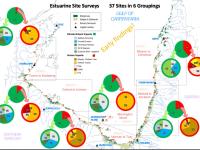
The major estuaries and their tidal wetlands of the Gulf of Carpentaria were impacted by mass dieback of mangroves in 2015-2016. To assess the full extent of the dieback and the major changes in the wetland areas, surveys in 2017 and 2019 were conducted along 31–37 major estuary mouths. Methods: The estuary surveys were conducted during aerial surveys using the same methods generally (see associated metadata record for more details: Gulf of Carpentaria Mangrove Aerial Shoreline Surveys 2017 & 2019 (NESP TWQ 4.13, JCU)).

Gulf of Carpentaria Mangrove Aerial Shoreline Surveys 2017 & 2019 (NESP TWQ 4.13, JCU)

Published on
08 November 2023

This project investigated the cause of the extensive areas of mangroves across the Gulf of Carpentaria which died in late 2015. Images from local fisherman showed extended impacted areas of more than 1,000 km where at least 7,400ha of mangroves had died in a matter of months. The project mapped the extent of the mass die-back, conducted aerial surveys to quantify shoreline condition, field studies to validate remote assessments and engaged with local aboriginal ranger groups to raise capacity for monitoring.

Benthic habitats of Yanyuwa Sea Country, Barni - Wardimantha Awara Indigenous Protected Area, Gulf of Carpentaria, Northern Territory, Australia (NESP MaC 1.12, JCU & CDU)

Published on
22 August 2023

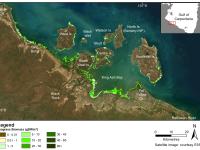
This dataset summarises benthic surveys in Yanyuwa Sea Country into 3 GIS shapefiles. (1) A point (site) shapefile describes seagrass presence/absence at 3248 sites surveyed by small vessel and helicopter. (2) The meadow shapefile describes attributes of 180 intertidal seagrass meadows. (3) The interpolation GeoTiff describes variation in seagrass biomass across the seagrass meadows.

eReefs Basemap - GIS layers Reefs, Rivers, Cities, Basins, Countries (AIMS)

Published on
10 August 2023

This dataset collection contains GIS layers for creating the AIMS eReefs visualisation maps (https://ereefs.aims.gov.au/). These datasets are useful for creating A4 printed maps of the Great Barrier Reef and the Coral Sea. It contains the following datasets: - Countries - Australia plus surrounding countries at 1:10M scale. Crop of Natural Earth Data 1:10 Admin 0 - Countries dataset. Allows filtering out of surrounding countries. - Cities - 21 Cities along the Queensland coastline.