
Articles
Published on
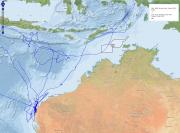
The Whale Shark is listed as vulnerable and migratory under Australia's Environment Protection and Biodiversity Conservation Act 1999 Act.
Published on
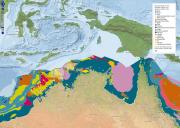
Geomorphology is a major driver of the type and abundance of organisms living on and near the sea floor. Much work has been done to define and characterise ocean geomorphology at spatial scales ranging from the entire world's oceans to the NW Australian region.
Use the interactive map below to see what geomorphological features occur within and beyond the Oceanic Shoals CMR. How to use the map Click on this icon at the top left of the map to see a full screen version.
Click on this icon also at the top left of the map to zoom in closer to (+) or further from (-) the map.
Published on
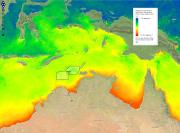
Sea surface temperature is the measure of how hot or corld the water in the ocean is at a given time and place.
Published on
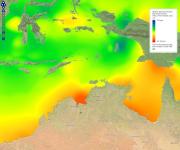
Salinity is the measure of how much salt is in the ocean at a given time and place (why is the ocean salty?).
Published on
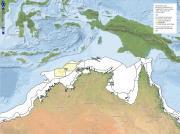
The Integrated Marine and Coastal Regionalisation of Australia (IMCRA v4.0) classified Australia's marine environment into ecologically relevant bioregions for regional planning.
Published on
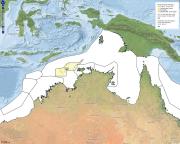
Coral reefs support a diverse array of life, including hard and soft corals, sponges, macroalgae and fish.
Published on
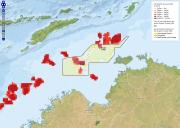
Seismic surveys have been used extensively in Australia by Geoscience Australia to map undersea geology and by various companies exploring for oil and gas deposits, particularly on the NW shelf (for example, at Scott Reef in 2007).
Published on
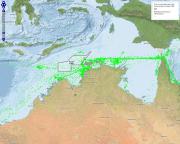
Surprisingly common across the world's oceans, bioluminescence (watch a video of how it works) occurs when a chemical reaction in living cells causes them to emit light - typically in shades of blue and green.
Published on
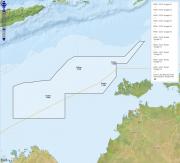
The RV Southern Surveyor was a 66.1 m research vessel operated by the Australian Commonwealth Scientific and Industrial Research Organisation from 2003-2013 (take a virtual tour).
Published on
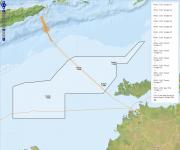
The RV Southern Surveyor was a 66.1 m research vessel operated by the Australian Commonwealth Scientific and Industrial Research Organisation from 2003-2013 (take a virtual tour).
Published on
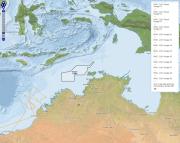
The RV Southern Surveyor was a 66.1 m research vessel operated by the Australian Commonwealth Scientific and Industrial Research Organisation from 2003-2013 (take a virtual tour).
Published on
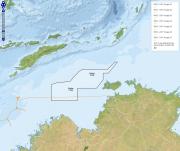
The RV Southern Surveyor was a 66.1 m research vessel operated by the Australian Commonwealth Scientific and Industrial Research Organisation from 2003-2013 (take a virtual tour).
Published on
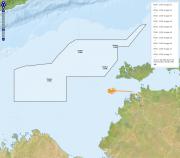
The RV Southern Surveyor was a 66.1 m research vessel operated by the Australian Commonwealth Scientific and Industrial Research Organisation from 2003-2013 (take a virtual tour).
Published on
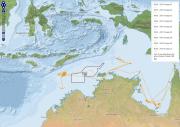
The RV Southern Surveyor was a 66.1 m research vessel operated by the Australian Commonwealth Scientific and Industrial Research Organisation from 2003-2013 (take a virtual tour).
Published on
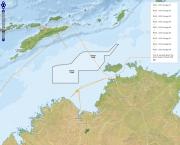
The RV Southern Surveyor was a 66.1 m research vessel operated by the Australian Commonwealth Scientific and Industrial Research Organisation from 2003-2013 (take a virtual tour).
Published on
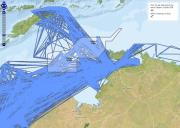
The RV Solander is a 34.9 m long marine research vessel operated by the Australian Institute of Marine Science (take a virtual tour, map its current position).
Published on
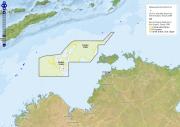
Australia is the fifth largest user of shipping in the world with more than 11,000 vessels from 600 overseas ports visiting Australia's 65 major ports each year.
Published on
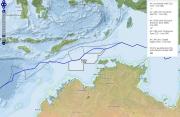
As an island continent, Australia has sovereign rights over a vast area of ocean, along with the fishery, mineral, and petroleum resources found in that area.
Published on
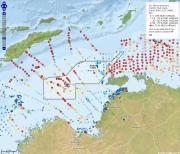
The type, size and distribution of sediments on the seabed plays an important role in determining the suitability of a given area for settlement by benthos.
Published on
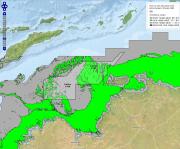
Dusky whaler sharks are widely distributed throughout the world's tropical and warm temperate waters (watch a video). This includes NW Australia's Oceanic Shoals CMR.
Use the interactive map below to explore the home range of these sharks within and beyond the CMR. How to use the map Click on this icon at the top left of the map to see a full screen version.
Click on this icon also at the top left of the map to zoom in closer to (+) or further from (-) the map.